


A lower home loan rate can look like an obvious win—until the fees arrive.
Refinancing in the Philippines can involve charges from your existing bank, the new lender, government and registration offices, insurers, notaries, and other service providers.
Some costs are fixed. Others depend on the loan amount, property location, appraised value, borrower’s age, and the terms of the existing mortgage.
This guide explains the main expenses to prepare for, how much they can change the result, and how to calculate whether switching lenders is still worth it.
Why Refinancing Creates a New Set of Costs
Refinancing replaces an existing home loan with a new one. The new bank must assess the borrower, appraise the property, prepare a new loan, settle the old balance, and register its mortgage interest over the property.
At the same time, the existing lender must calculate the settlement amount, process the loan take-out, cancel or release its mortgage, and release the collateral documents when the account has been cleared.
This creates four broad cost groups:
- Charges for leaving the existing lender
- Charges for opening the new loan
- Taxes, legal, title, and registration expenses
- Insurance and other ongoing requirements
The exact amount can vary widely. Published bank fees can also change, and promotional waivers may cover only selected charges.
1. Costs From Your Existing Lender
Before applying elsewhere, request a written statement of account for full settlement. Ask the bank to show every amount needed to close the loan and release the title.
Possible charges include:
- Loan take-out or prepayment processing fees
- Full-payment processing fees
- Certificate of outstanding balance or statement fees
- Document certification charges
- Cancellation or release-of-mortgage fees
- Unpaid insurance, interest, or account charges up to the settlement date
- Penalties specifically allowed under the existing loan contract
These fees are not standard across banks.
For example, Metrobank’s published consumer loan fee schedule states that its processing fee for loan take-out or refinancing is 2% of the outstanding balance or ₱15,000, whichever is higher .
Its 2026 fee update also lists a ₱7,500 prepayment processing fee.
BDO publishes a different structure. It states that there is no pre-termination fee for fully paying a home loan, but it charges a one-time ₱3,500 processing fee.
These examples show why a generic refinancing-cost percentage can be misleading. On a ₱3 million outstanding balance, a 2% loan take-out fee alone would be ₱60,000. Another lender may charge a much smaller fixed amount.
2. Costs From the New Lender
The new bank may charge for assessing the property, processing the application, documenting the loan, and arranging the mortgage.
Common charges include:
- Property appraisal
- Title verification or investigation
- Processing or handling fees
- Service fees
- Notarial charges
- Mortgage documentation
- Document preparation or certification costs
Current published examples show how these charges can differ:
- BPI lists a ₱5,000 appraisal fee, ₱10,000 processing and handling fee, and ₱1,300 notarial fee for housing loans. Other items depend on the loan or annotated amount.
- BDO lists a ₱5,000 appraisal fee for collateral within 30 kilometres of a branch, or ₱5,500 outside that radius, plus a ₱3,000 handling fee and ₱200 per document for notarisation.
- Security Bank lists an appraisal fee of ₱3,500 in Metro Manila and ₱4,000 in CALABARZON, with other provinces varying by location.
Security Bank’s refinancing page also estimates other fees and charges at 2.5% to 3% of the approved loan amount, alongside listed mortgage and insurance costs.
Treat these as examples of published lender pricing, not quotations for your transaction. Ask the new lender which charges are included in its estimate and which are paid separately.
3. Documentary Stamp Tax
A new loan can attract documentary stamp tax, or DST. Under the current tax rule for debt instruments, the rate is 0.75% of the issue price, also commonly expressed by banks as ₱1.50 for every ₱200 of the loan amount.
For illustration:
- ₱1 million loan: approximately ₱7,500 DST
- ₱3 million loan: approximately ₱22,500 DST
- ₱5 million loan: approximately ₱37,500 DST
The actual treatment should be confirmed in the lender’s disclosure and final fee computation.
Republic Act No. 12214 also provides that only one documentary stamp tax is imposed across the loan agreement, promissory notes, mortgage, and other contracts issued to secure the same loan.
4. Registration, Title, Cancellation, and Legal Costs
Refinancing usually requires the old mortgage to be cancelled or released and the new mortgage to be registered or annotated. This can involve the Registry of Deeds and related documentation.
Potential expenses include:
- Cancellation of the existing mortgage
- Registration or annotation of the new real estate mortgage
- Certified true copies of the title and supporting documents
- Notarial charges
- Document delivery, facilitation, or service-provider costs
- Corrections or re-verification if the title or property records contain issues
Registration charges can be variable. Metrobank, for example, lists its registration fee as subject to a quotation from the Register of Deeds.
BPI states that its cancellation-of-mortgage fee for a loan take-out depends on the amount annotated on the title.
Ask whether the bank’s quoted service fee or mortgage fee already includes DST, registration, notarisation, and title-related work. Adding inclusive estimates and the same component fees again would overstate the cost.
5. Mortgage Redemption and Fire Insurance
Home lenders commonly require mortgage redemption or credit life insurance and fire insurance. These protect the loan and property against specified risks.
Premiums may depend on:
- The outstanding loan amount
- The borrower’s age and health assessment
- The insured value of the building or improvements
- Property location and risk classification
- Policy term
- The insurer and lender arrangements
Do not assume that insurance already paid to the old lender will automatically transfer or be refunded in full.
Confirm the cancellation date, any available refund, and the start date of the replacement cover so you can avoid an unintended gap or unnecessary overlap.
Also separate first-year or upfront insurance costs from premiums you would have paid anyway under the current loan. The full premium is not always an incremental refinancing cost.
6. Costs That Are Easy to Miss
Some expenses do not appear in a headline bank-fee table. Check for:
- New bank account opening or maintaining-balance requirements
- Updated tax declarations, tax clearances, and real property tax receipts
- Special power of attorney expenses for an OFW or absent co-owner
- Consularisation, apostille, courier, and overseas document costs
- Repeat appraisal or title verification charges
- Unpaid property taxes or title issues that must be resolved
- Valuation shortfalls that require the borrower to contribute cash
- Interest timing while the old loan is being settled
A valuation shortfall can be especially important. If the new bank will lend only a percentage of the appraised value and that amount is below the settlement figure, the borrower may need to pay the difference.
That cash contribution is not technically a fee, but it affects whether the refinance can proceed.
An Illustrative ₱3 Million Refinancing Budget
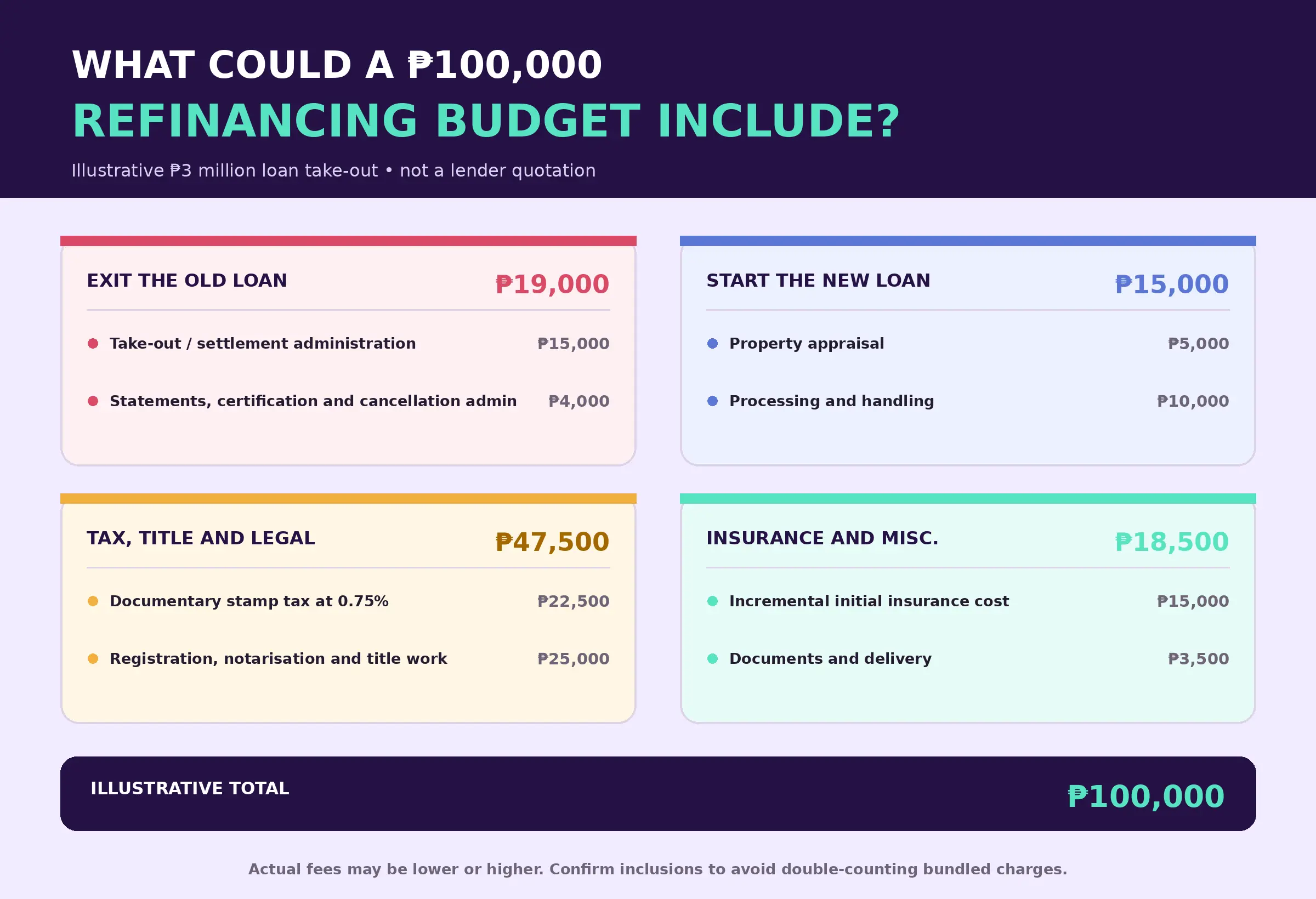
Suppose a homeowner wants to refinance a ₱3 million outstanding balance. The following budget is purely illustrative and does not represent one bank’s quotation.
- Existing-lender take-out or settlement administration: ₱15,000
- Statements, certifications, and cancellation administration: ₱4,000
- New property appraisal: ₱5,000
- New-loan processing and handling: ₱10,000
- Documentary stamp tax at 0.75%: ₱22,500
- Registration, notarisation, and title-related work: ₱25,000
- Incremental initial insurance cost: ₱15,000
- Miscellaneous documents and delivery: ₱3,500
Illustrative total: ₱100,000
The actual total could be lower if fees are waived or the existing lender charges little for full settlement.
It could be much higher if the old lender charges a percentage-based take-out fee, registration costs are substantial, insurance is more expensive, or the title requires additional work.
How Fees Change the Refinancing Result
Now assume that the homeowner has 15 years remaining on the ₱3 million balance.
- Current loan: 10%, approximately ₱32,238 per month
- New loan: 7.5%, approximately ₱27,810 per month
- Monthly payment saving: approximately ₱4,428
- Gross remaining saving before refinancing costs: approximately ₱797,001
With ₱100,000 in switching costs:
- Simple break-even: approximately 23 months
- Estimated net saving over 15 years: approximately ₱697,001
Break-even period = total refinancing cost ÷ monthly payment saving
In this example, the costs do not eliminate the benefit because the rate difference is large and many years remain.
But the same fees could destroy the savings on a smaller balance or a loan with only a few years left.
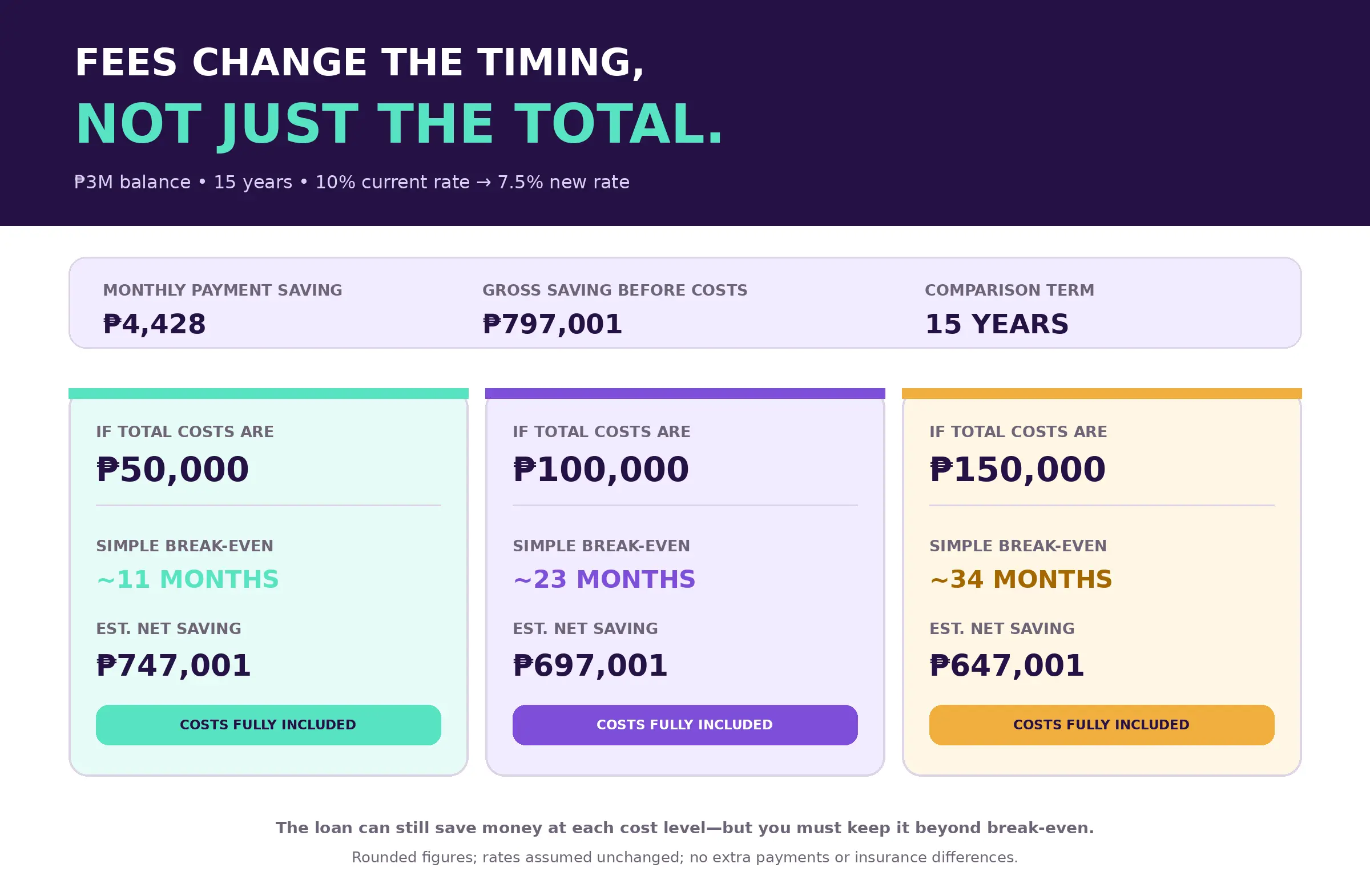
Break-even is only a first screen. It assumes that the new monthly saving continues.
If the new rate is fixed for one year and then reprices, the actual saving may change. Compare the fixing period and future repricing rules as well.
Beware of Fee Waivers
Promotions can reduce the cost of refinancing, but “fees waived” does not always mean the entire transfer is free.
A waiver may apply only to:
- The new bank’s processing fee
- The first appraisal
- Selected bank charges up to a limit
- Accounts released within the promotion period
It may exclude:
- Charges from the existing lender
- DST or other government charges
- Registry of Deeds fees
- Insurance premiums
- Notarial and third-party costs
- Expenses caused by title or document issues
Ask for the normal charge, the amount waived, and the remaining amount you must pay.
Also confirm whether the waiver must be repaid if the loan is closed within a certain period.
Ask for These Figures Before Deciding
From Your Existing Lender
Request:
- The outstanding principal and settlement figure for a specific date
- Daily interest or adjustment if settlement is delayed
- Take-out, prepayment, and full-payment processing charges
- Document and certification fees
- Mortgage cancellation and collateral-release costs
- Expected title-release timeline
- Treatment of unused insurance premiums
From the New Lender
Request:
- Approved loan amount and appraised property value
- Complete bank and third-party fee breakdown
- EIR and disclosure statement
- Interest rate and fixing period
- Proposed term and monthly amortization
- DST, registration, notarisation, and mortgage fees
- Initial and recurring insurance premiums
- Charges deducted from the loan proceeds
- Any promotional waiver conditions
The Bangko Sentral ng Pilipinas explains that the effective interest rate reflects the true cost of a loan and advises borrowers to compare EIRs.
It also states that the financial institution should provide the actual EIR computation with full disclosure of all fees and charges.
Calculate Net Savings—Not Just Fees
The goal is not to find a refinance with zero cost. The goal is to determine whether the financial benefit is larger than the cost and arrives soon enough to matter.
Use these calculations:
Net lifetime saving = remaining cost of current loan − total cost of new loan − refinancing costs
Break-even period = refinancing costs ÷ monthly payment saving
Then test the result against your likely plans. If you expect to sell, prepay, or move again before break-even, the projected long-term saving may never arrive.
Keep the remaining term the same for the first comparison. Extending the loan can reduce the payment while increasing total interest, which can make a costly refinance appear more attractive than it is.
Prepare for the Transfer Before Committing
- Obtain a written settlement estimate from the existing lender.
- Get an itemised fee estimate from the new lender.
- Confirm which fees are included, waived, financed, or paid in cash.
- Check the approved take-out amount against the settlement balance.
- Compare the EIR, monthly payment, and total remaining cost.
- Calculate break-even using the full cost—not only new-bank fees.
- Confirm final approval and documentary conditions before closing the old loan.
Could Refinancing Still Save You Money?
Estimate your potential savings or compare home-loan options from Philippine banks based on your current loan and financial goals.
See the Full Cost Before You Switch
Refinancing can still produce major savings after fees. The danger is making the decision before the complete cost is visible.
Use Estra’s refinancing calculator to compare your existing loan with a potential new offer using the same balance and repayment term.
Once you receive an itemised switching-cost estimate from the lenders, subtract those costs from your projected savings and calculate how long the monthly reduction would take to recover them.
Sources
- Bangko Sentral ng Pilipinas — Loan Calculator and effective interest rate guidance
- Republic Act No. 12214 — Documentary stamp tax on debt instruments
- BPI — Auto Loan and Housing Loan Fees and Charges
- BDO — Home Loan fees and service information
- Metrobank — Home and Car Loans Rates and Fees
- Metrobank — Updates to Car and Home Loan Service Fees
- Security Bank — Home Loan Refinancing
Sources checked 20 October 2026. Bank fees, promotions, insurance costs, government charges, and eligibility rules can change. Request a current written computation from the relevant institutions.