

Imagine reducing your home loan payment by around ₱8,000 a month. That could cover groceries, school expenses, or give your household room to breathe.
Now imagine discovering that the switch would leave you paying around ₱82,000 more by the time the loan is finished.
Both can happen in the same refinancing deal.
The reason is easy to miss: your monthly payment tells you what leaves your account each month. It does not tell you the full cost of repaying your home.
Before refinancing your home loan in the Philippines, look at the interest rate, the remaining repayment period, and the cost of switching together. Here is how those numbers can change the outcome.
How a Lower Payment Can Become a Bigger Bill
Refinancing replaces your existing home loan with a new one. The new loan pays off the old balance, and you repay the replacement loan under its agreed terms.
A lower interest rate can reduce your payment. Giving yourself more years to repay can reduce it further. But those extra years also mean more monthly payments and more time for interest to accumulate.
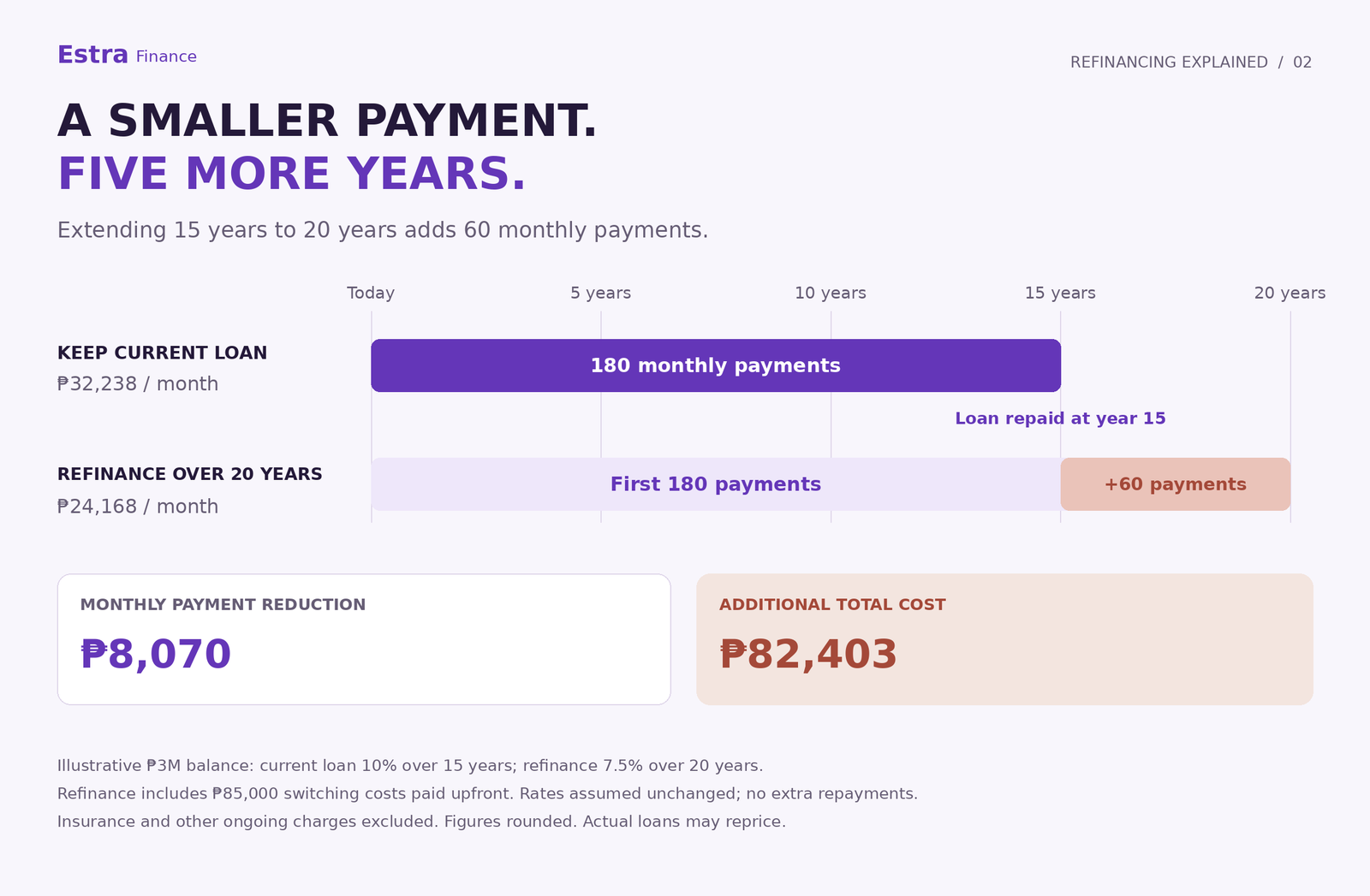
If you have 15 years left and refinance over 20 years, you have added 60 payments. Even with a lower rate, the interest over that longer period, plus switching costs, can exceed what you would otherwise pay.
The important comparison is everything you still have to pay from today onward. Payments already made belong to the past and should not be added to one option while being left out of another.
One Outstanding Balance, Three Different Outcomes
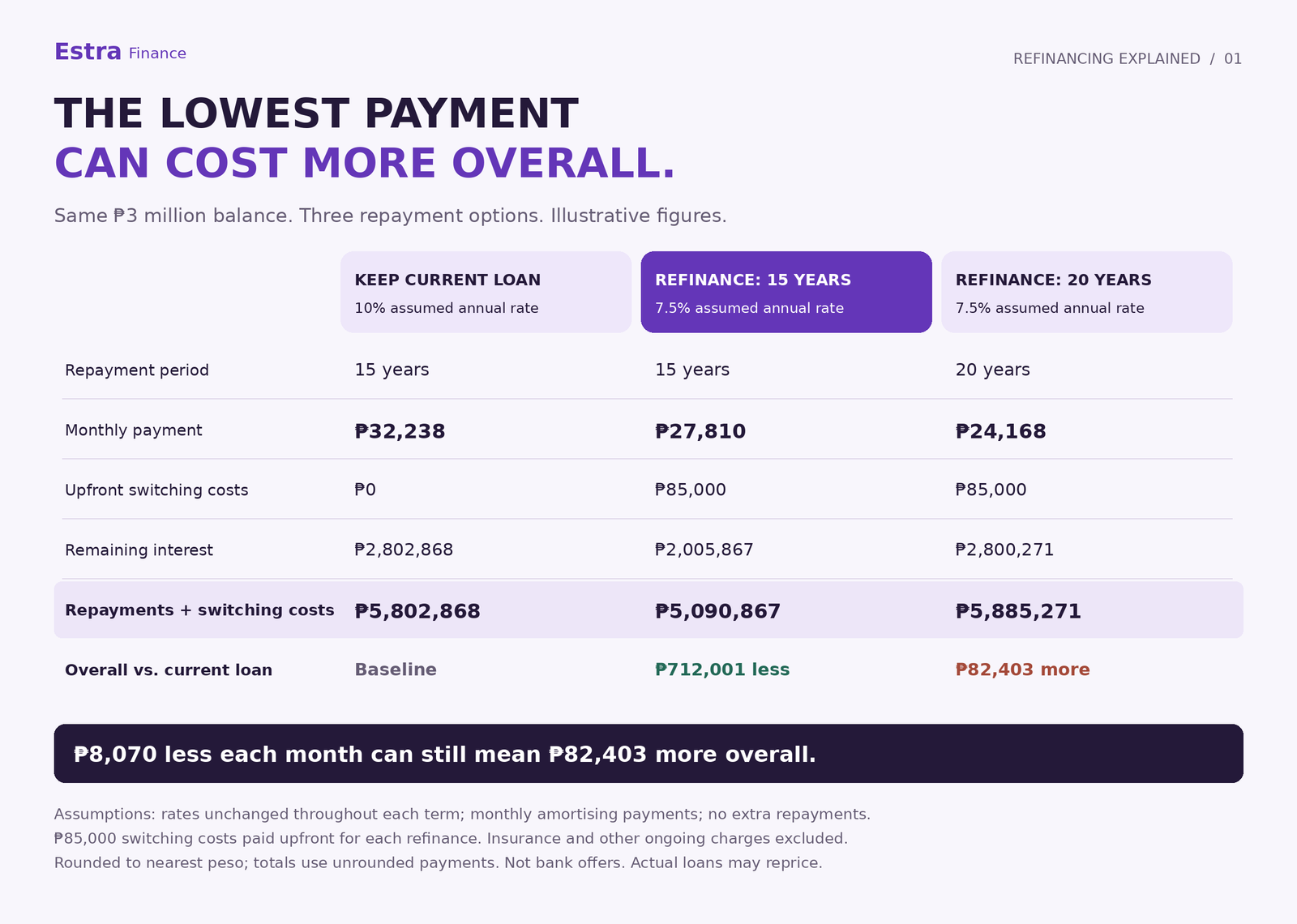
Consider a homeowner with a ₱3 million outstanding balance, 15 years remaining, and a 10% annual interest rate. They are considering refinancing at 7.5%, with ₱85,000 in total switching costs paid upfront.
The comparison below shows keeping the current loan, refinancing over the same remaining period, and refinancing over a longer period.
This is an illustrative calculation, not a bank offer. To isolate the effect of the repayment term, it assumes each rate stays unchanged for the entire period. Actual Philippine loans may reprice after their fixing period. It also assumes monthly amortising payments, no extra repayments, and excludes insurance and other ongoing charges.
Figures are rounded to the nearest peso. Totals and differences use unrounded monthly payments.
The 20-year option reduces the monthly payment by approximately ₱8,070. However, its total interest is almost the same as keeping the current loan. Once the ₱85,000 switching cost is included, it costs approximately ₱82,403 more overall.
The 15-year refinancing option produces a different result. It reduces the payment by approximately ₱4,428 a month while lowering the total remaining cost by approximately ₱712,001, including switching costs.
Under these assumptions, the smallest monthly payment produces the highest total bill.
Your Fixing Period Is Different From Your Loan Term
A five-year fixed rate does not mean you will repay the loan in five years.
The fixing period is how long the agreed interest rate applies. The loan term is the repayment period. After the fixing period, the rate may change according to your loan agreement. Security Bank, for example, explains that its loans reprice annually after the fixing period based on the prevailing repricing rate.
That matters when reading any lifetime savings estimate. Applying an initial rate across 15 or 20 years is an assumption, not a promise about future payments.
Ask what happens after the initial fixing period. Compare a scenario where rates remain unchanged with one where they rise. If a projection assumes a future repricing rate, make sure that assumption is visible.
When a Lower Monthly Payment Can Still Be Worth It
Reducing the total cost is not every household’s only priority.
If your income has fallen or essential expenses have increased, a smaller required payment may make the loan more manageable. You may knowingly accept a higher total cost to obtain that breathing room.
The mistake is assuming that monthly relief automatically equals overall savings.
Before extending the term, establish what you are trying to achieve. Is it a more manageable payment today, less interest overall, an earlier repayment date, or a balance between those goals? Then judge each offer against that priority.
Include the Full Cost of Switching
Get an itemised settlement quotation from your existing bank and a written breakdown of the new lender’s charges.
Depending on the loan, relevant costs can include processing, appraisal, documentary stamps, mortgage registration or cancellation, insurance, and applicable early-settlement charges. BPI’s published housing-loan fee schedule illustrates several of these categories.
Our ₱85,000 example is a hypothetical combined switching cost, not a standard Philippine refinancing fee. Your actual amount will depend on the lenders, property, loan, and applicable terms.
If fees are added to the new loan rather than paid upfront, the opening balance increases and those financed fees can also attract interest. The comparison needs to reflect that.
Five Questions Before Accepting a Lower Payment
- Am I comparing the same amount of debt? Check the outstanding balance and whether fees have been added to the replacement loan.
- Am I adding years? Compare the proposed term with the years remaining on your current loan.
- What will switching actually cost? Include applicable charges from both lenders.
- What is the total remaining cost? Add scheduled repayments and upfront switching costs, then account for relevant ongoing charges. Avoid counting financed fees twice.
- What happens after the fixed rate ends? Identify the repricing assumptions behind the projected savings.
A useful starting point is to request a refinancing quote using your current remaining term. Then compare longer or shorter terms to see what changes and whether the payment remains affordable.
Could Refinancing Save You Money?
Estimate your potential savings or compare home-loan options from Philippine banks based on your situation and financial goals.
Compare the Monthly Relief With the Total Cost
Use Estra’s refinancing savings calculator to estimate what switching could mean for your loan. Have your outstanding balance, current rate, remaining term, proposed new terms, and switching-cost estimates ready.
Check which costs and future-rate assumptions the calculator includes. Use the result as a starting point, then confirm the terms and charges with the lenders before deciding.
A better refinancing decision starts with knowing both what you will pay each month and what you could pay overall.
Sources
[1] Security Bank Home Loan Refinancing — fixing-period explanation
[2] BPI Auto Loan and Housing Loan Fees and Charges
Bank pages checked 19 October 2026. Example calculations use the standard monthly amortisation formula and the assumptions stated above.