


A higher home loan rate can turn a manageable monthly payment into a serious budget problem. When the notice arrives, the natural reaction is to look for the lowest rate advertised by another bank.
But the lowest quoted rate is not automatically the best decision. Switching banks can reduce your payment and interest, but it can also bring appraisal, registration, documentary, insurance, processing, and settlement costs.
Staying can avoid those expenses, while still leaving room to ask your current bank for a better offer.
Here is how to work that out.
First, Understand Why Your Rate Changed
Your loan term and your rate-fixing period are two different things.
You might have a 20-year home loan with a rate fixed for only one, three, or five years. Once that fixed period ends, the bank may reprice the loan based on the method set out in your contract.
That can change your interest rate and monthly amortization even though you have many years left to pay.
This is a normal feature of many Philippine home loans, but the exact process varies by lender and contract. For example, Security Bank states that after the fixing period, its home loan rate is reviewed and adjusted annually.
BDO likewise explains in its home loan terms that existing borrowers are repriced after their initial fixing period under the bank’s applicable pricing rules.
That means the first step is to read the actual repricing notice and your loan documents. Do not make a decision from the new rate alone.
Confirm these details with your bank:
- The new interest rate and its effective date
- Your new monthly amortization
- Your outstanding principal balance
- Your remaining loan term
- How long the new rate will apply
- When and how the loan will be repriced again
- Whether your bank can review the new rate
- Any fee for changing the rate, term, or other loan conditions
You Have Three Practical Options
1. Accept the New Rate and Stay
Staying is the simplest route. There is no new application, property appraisal, title transfer process, or coordination between two banks.
It may be sensible when your remaining balance is already small, only a few years remain, or the savings from another offer would be too small to recover the cost and effort of switching.
The trade-off is that you accept the higher monthly payment and the additional interest it creates.
2. Ask Your Current Bank for a Better Rate
Before applying elsewhere, ask your lender whether it can review your repriced rate. Banks do not have to approve a lower rate, but a review can be worth requesting, especially if you have paid consistently and can show a serious competing offer.
Ask for the proposal in writing. It should state the revised rate, fixing period, monthly amortization, next repricing date, and any modification fee.
As one published example, BPI lists a fee for loan modification services that include a rate change. Your own bank’s charges and approval process may differ.
This option can be attractive because even a modest rate reduction may produce meaningful savings without the full cost of transferring the loan.
3. Refinance With Another Bank
Refinancing replaces your current home loan with a new loan from another lender. The new bank pays off the outstanding balance, and you begin paying under the new loan’s terms.
A lower rate can reduce both your monthly payment and remaining interest. However, the new loan usually requires fresh credit assessment and property documents.
You may also face expenses related to appraisal, processing, insurance, taxes or documentary charges, registration, cancellation and annotation of the mortgage, and requests for records from your existing bank.
Approval is not automatic. The property, title, income, repayment capacity, and outstanding balance must meet the new lender’s requirements.
An Illustrative Three-Option Comparison
Suppose a homeowner has:
- ₱3,000,000 left on the loan
- 15 years remaining
- A newly repriced rate of 10% per year
The current bank is willing to review the rate to 8.5% for an illustrative ₱5,000 modification cost. Another bank offers 7.5%, with estimated switching costs of ₱85,000.
For a clean comparison, assume each rate stays unchanged for all 15 remaining years, payments are monthly, costs are paid upfront, and there are no extra payments or ongoing insurance charges.
Actual home loan rates may be fixed for a shorter period and reprice again.
Under those assumptions:
- Stay at 10%: about ₱32,238 per month, with a total remaining cost of approximately ₱5.803 million.
- Current bank at 8.5%: about ₱29,542 per month. Including the ₱5,000 cost, the total remaining cost is approximately ₱5.323 million, saving roughly ₱480,274 compared with staying.
- Switch at 7.5%: about ₱27,810 per month. Including ₱85,000 in costs, the total remaining cost is approximately ₱5.091 million, saving roughly ₱712,001 compared with staying.
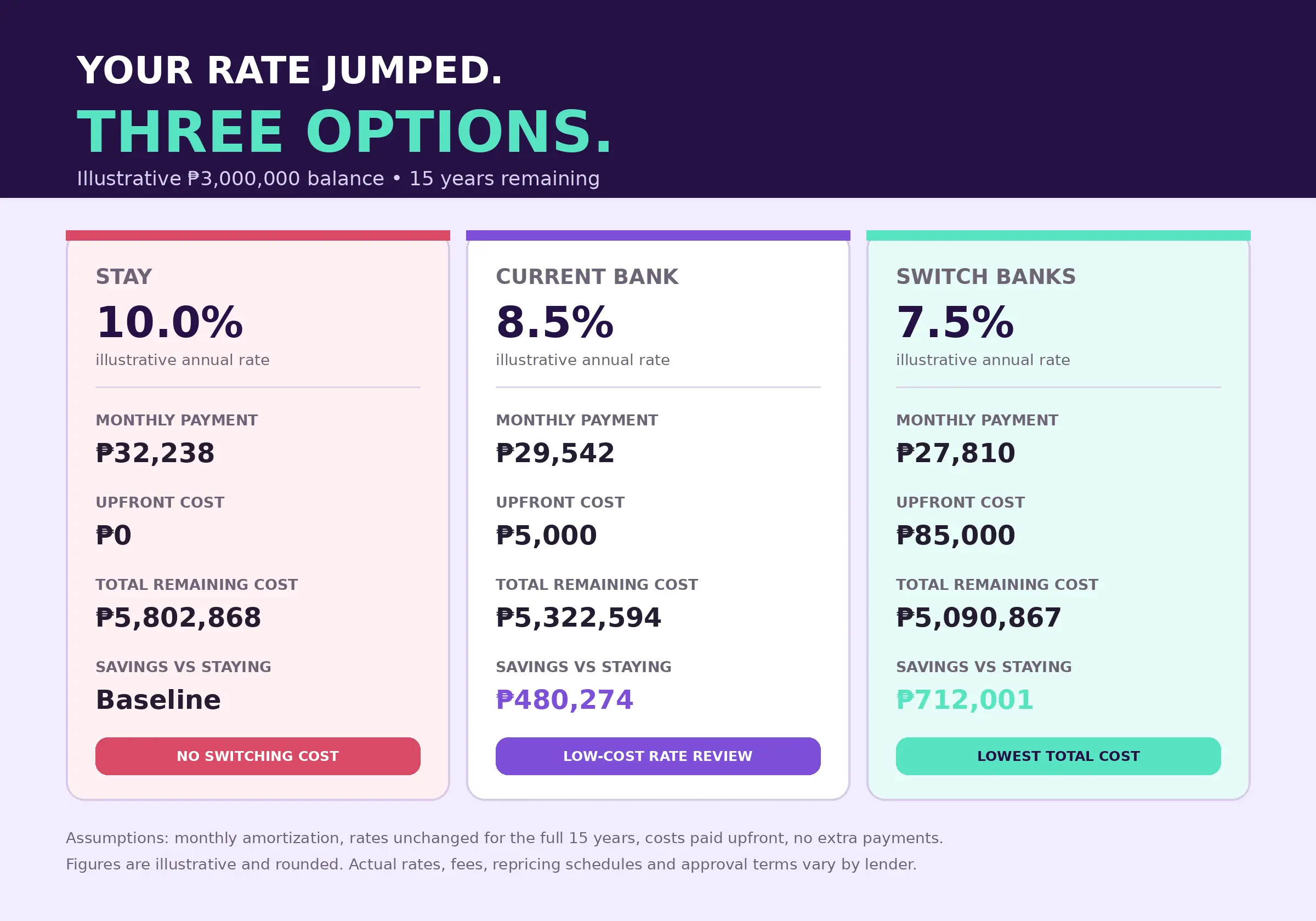
The switching offer produces the lowest monthly payment and the lowest total cost in this example.
But that still does not tell you how long you must keep the loan before switching pays off.
Calculate the Break-Even Period
The break-even period estimates how long your monthly savings take to recover the upfront cost.
Break-even period = upfront refinancing cost ÷ monthly payment savings
Compared with staying at 10%, switching saves about ₱4,428 per month. Dividing the ₱85,000 switching cost by that monthly saving gives a break-even period of roughly 19 months.
That sounds compelling. However, the more useful comparison is often the new bank’s offer against the best revised offer from your current bank.
Compared with the 8.5% reviewed rate, switching saves only about ₱1,732 more per month and requires ₱80,000 more upfront.
The extra cost takes about 46 months, or approximately three years and ten months, to recover.
If you expect to sell the property, make a large prepayment, or refinance again before then, the lower outside rate may not deliver the expected advantage.
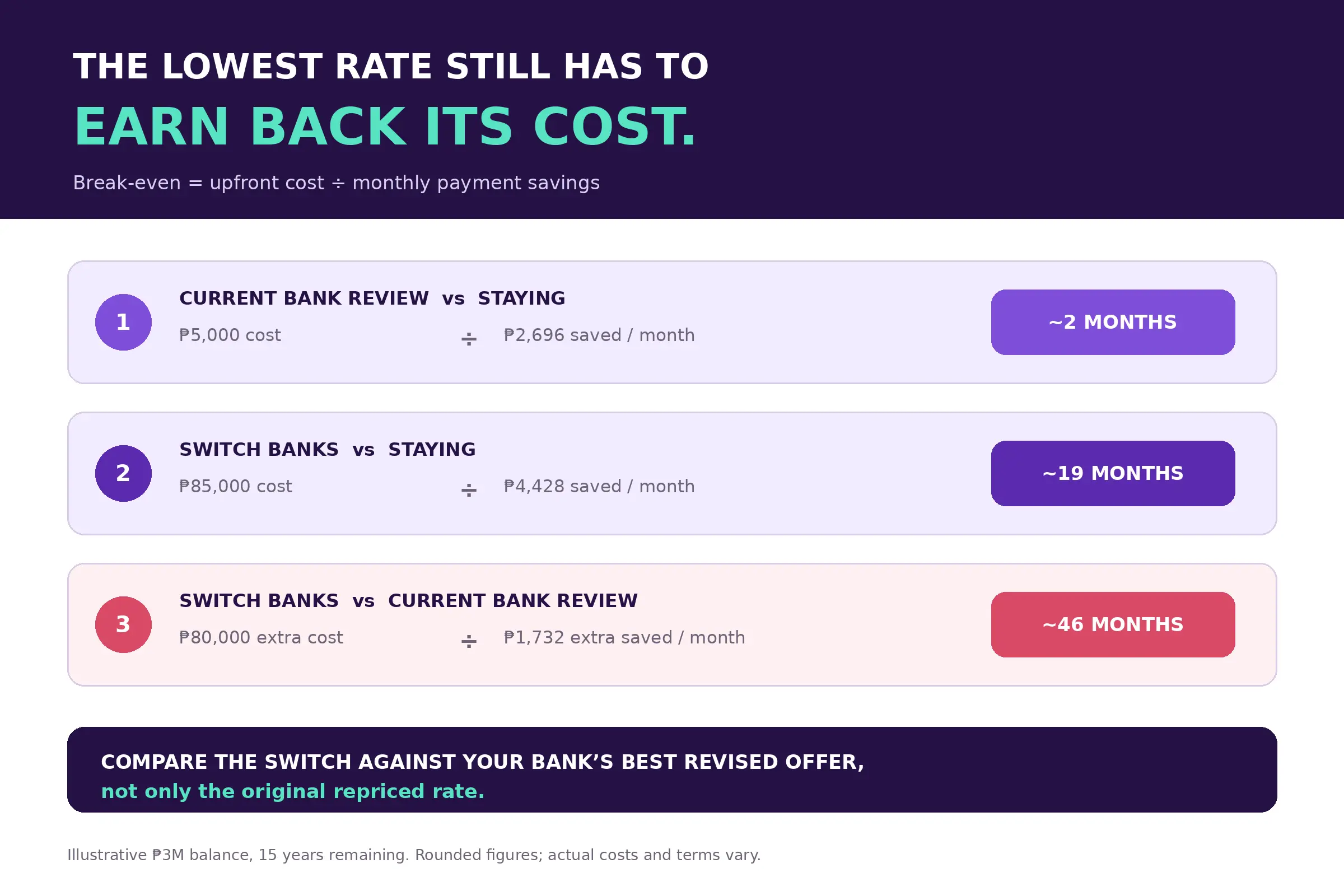
Break-even is a useful first screen, but it is not the whole decision. It does not capture future repricing, early settlement charges, differences in insurance, or the value of keeping cash available today.
Compare Equivalent Offers
A fair comparison keeps the important variables aligned. For each option, record:
- Outstanding balance financed
- Interest rate
- Rate-fixing period
- Remaining or proposed loan term
- Monthly amortization
- Total interest over the comparison period
- Every upfront and ongoing fee
- Early settlement or prepayment terms
- What happens after the fixed-rate period
Be especially careful with the loan term. A lender can create a much lower monthly payment by extending the repayment period.
That may improve monthly cash flow while increasing the total amount paid. If the goal is to judge the rate and fees, compare offers using the same remaining term first. Then model a longer term separately as a cash-flow choice.
The Bangko Sentral ng Pilipinas advises borrowers to compare the effective interest rate, or EIR, because it reflects the true cost of a loan more fully than the stated interest rate alone.
Ask each lender for the disclosure statement and a complete breakdown of charges before deciding.
Staying May Make Sense When
- Only a small balance or short repayment period remains
- The competing rate is only slightly lower
- Switching costs create a long break-even period
- You expect to sell the property or repay the loan soon
- Your current bank offers a competitive revised rate
- You value avoiding a new approval and documentation process
- The competing offer uses a longer term to make the payment appear cheaper
Staying does not have to mean passively accepting the first repriced rate. Ask for the bank’s best written offer and compare it with the market.
Switching May Make Sense When
- The net savings remain material after all costs
- You expect to keep the loan beyond the break-even point
- The new term is the same as, or shorter than, your remaining term
- The new rate-fixing period suits your plans
- The future repricing method and exit terms are acceptable
- The lower payment gives your household meaningful budget room
- Your income, credit profile, property, and documents are likely to qualify
The strongest case combines lower monthly payments, lower total cost, a reasonable break-even period, and terms you can live with after the introductory rate ends.
What to Do After Receiving a Repricing Notice
- Request an updated statement from your current bank. Confirm your balance, remaining term, new payment, and any settlement or document fees.
- Ask for a rate review. Get the bank’s best revised proposal in writing, including all charges.
- Collect comparable refinancing offers. Use the same balance and remaining term whenever possible.
- Add every cost. Include charges from both the old and new banks, plus third-party expenses.
- Compare the EIR, monthly payment, and total cost. A single headline rate is not enough.
- Calculate break-even twice. Compare switching against staying and against your current bank’s revised offer.
- Stress-test future payments. If the new rate will reprice, check whether your budget could handle a higher payment later.
- Apply before committing. A quote is not an approval. Confirm the final terms before arranging settlement of the existing loan.
Should You Stay or Switch Banks?
Estimate your potential refinancing savings or compare home-loan options from Philippine banks based on your situation and goals.
Make the Decision With the Full Numbers
A rate increase is a good reason to review your home loan, but urgency should not replace calculation.
Your current bank may still be competitive after a rate review. A new lender may offer greater long-term savings. In some cases, the cost of moving means staying is the better choice.
Use Estra’s refinancing calculator to compare your current loan with a potential refinancing offer using the same balance and repayment term. Compare the estimated monthly payment and total interest, then use the actual switching costs supplied by the lenders to work out your break-even period.
Sources
- Bangko Sentral ng Pilipinas — Loan Calculator and effective interest rate guidance
- Security Bank — Home Loan Repricing Update
- BDO — Home Loan Terms and Conditions, January 2026
- BDO — Home Loan fees and service charges
- BPI — Updates on Select Service Fees for Retail Loans
Sources checked 19 October 2026. Bank policies, rates, fees, and eligibility rules can change. Confirm the latest terms directly with the lender.