

Refinancing can save a homeowner hundreds of thousands—or even more than a million pesos. It can also create a smaller monthly payment while quietly increasing the total cost of the loan.
Both outcomes are possible because refinancing is not automatically good or bad. It is a new financial decision with a new rate, new term, new fees, new approval process, and usually a new rate-fixing period.
The right question is not simply, “Can I get a lower interest rate?”
Here is how Filipino homeowners can tell the difference.
What Refinancing Actually Changes
Home loan refinancing—also called a loan take-out—replaces an existing housing loan with a new one. The new lender settles the outstanding balance with the original lender, and the homeowner begins paying the new loan under its approved terms.
In the Philippines, some banks expressly offer refinancing or loan take-out as a housing-loan purpose. Pag-IBIG Fund also publishes a refinancing requirements checklist.
This does not mean that every borrower or property will qualify. The new lender may reassess:
- The borrower’s income and repayment capacity
- Employment or business history
- Credit and payment history
- The property’s current appraised value
- The title, tax declarations, and other collateral documents
- The outstanding loan balance
- The borrower’s age at loan maturity
For example, Security Bank’s published refinancing page states that its refinancing loans start at ₱1 million and may be limited to 80% of the property’s appraised value.
It also lists proof of recent amortization payments and a statement of account from the existing mortgagee bank among its loan take-out documents.
These are lender-specific requirements, but they show why refinancing should be treated as a fresh application, not an automatic transfer.
The Four Numbers That Decide Whether Refinancing Works
1. Your Remaining Loan Balance
This is the amount the new lender needs to take out. A large remaining balance gives a lower rate more principal to work on, which can create bigger savings.
If the balance is already small, the savings may not justify the transfer costs.
2. Your Remaining Term
The number of years left matters as much as the rate. A borrower with 18 years remaining has much more time to benefit from a rate reduction than someone with only three or four years left.
Keep the remaining term the same when making the first comparison. If the new lender proposes a longer term, calculate that separately so you can see how much of the lower payment comes from the rate and how much comes from adding more years.
3. The Complete Cost of Switching
Refinancing costs can include charges from both lenders and third parties. Depending on the transaction, these may include:
- Appraisal and processing fees
- Loan take-out or prepayment processing fees
- Documentary and notarial expenses
- Registration, cancellation, and mortgage annotation expenses
- Document request and certification fees
- Mortgage redemption insurance and fire insurance
- Any penalty or charge under the existing loan contract
Published charges differ materially by bank. Security Bank, for example, estimates other home-loan fees and charges at 2.5% to 3% of the approved loan amount, in addition to listed items such as appraisal and insurance.
Metrobank’s published service-fee update states that, effective 1 August 2026, its home-loan take-out fee is 2% of the outstanding balance or ₱15,000, whichever is higher.
These are examples, not universal charges. Request a written settlement figure and fee breakdown for your own loan.
4. How Long You Expect to Keep the New Loan
The loan needs enough time to recover the upfront cost and produce real savings.
Your likely holding period may be shorter than the contractual term if you plan to sell the property, make a major prepayment, or move again.
That is why break-even matters:
Break-even period = total switching cost ÷ monthly payment savings
If refinancing costs ₱100,000 and saves ₱4,000 per month, the simple break-even period is 25 months.
Refinancing deserves a closer look if you expect to keep the loan well beyond that point. It becomes much less attractive if you may exit within two years.
When Refinancing Usually Makes Sense
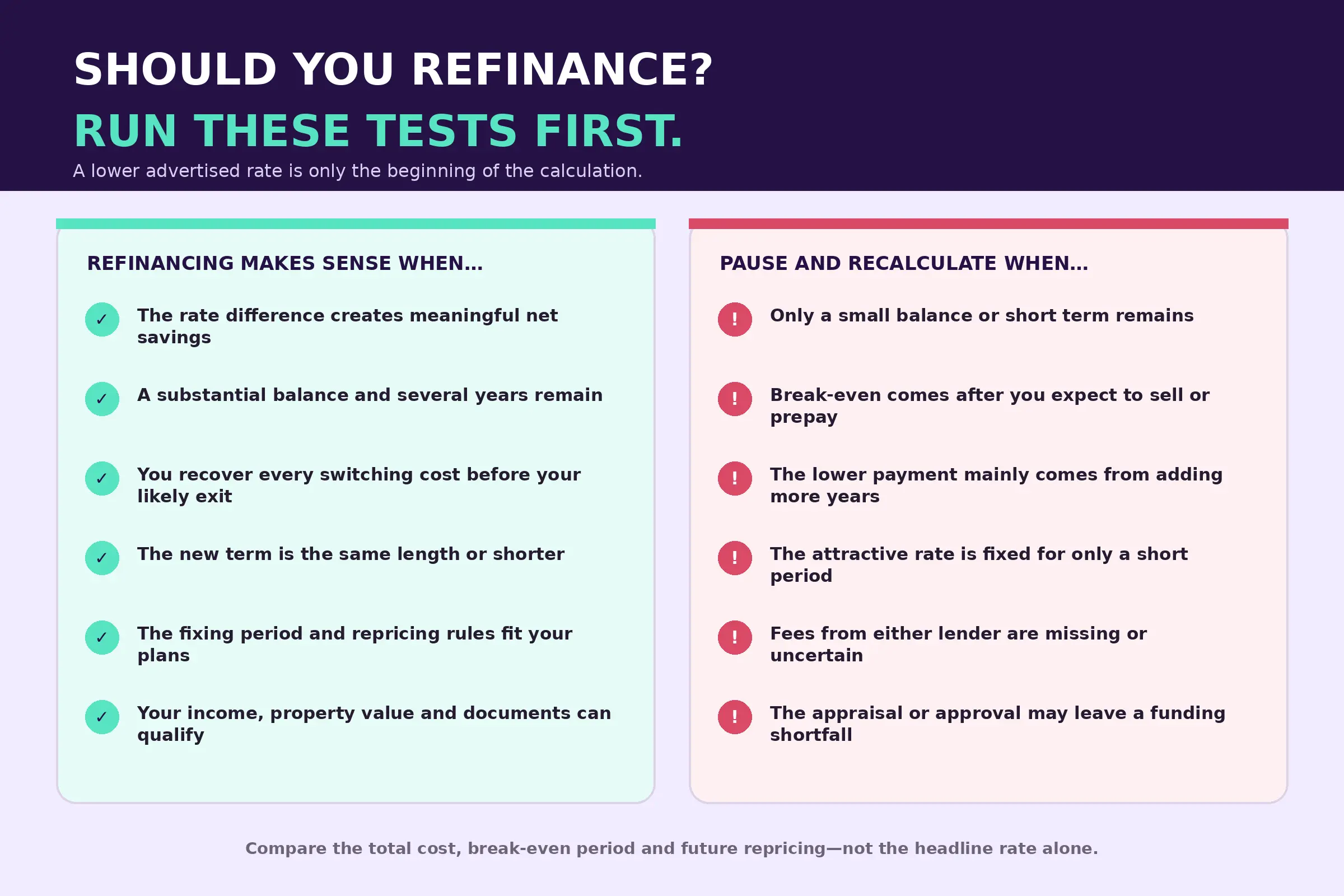
The Rate Difference Is Meaningful
A small change in rate may not overcome the costs of moving. A larger difference can create substantial savings, especially when the outstanding balance and remaining term are both significant.
The headline rate still needs context. Check how long it is fixed, when it will reprice, and how the next rate will be determined.
A low one-year rate may be less valuable than a slightly higher rate fixed for longer if payment stability matters to you.
You Still Have Many Years and a Substantial Balance Remaining
Interest savings need time to accumulate. Refinancing is often more promising earlier or in the middle of a long home loan, while a meaningful balance remains.
This does not create a universal “best year” to refinance. The decision depends on the current rate, new rate, fees, balance, and remaining term together.
You Recover the Costs Comfortably Before Your Likely Exit
A break-even period should fit your real plans. If the costs are recovered in 16 months and you expect to keep the property and loan for another decade, the numbers may be strong.
If break-even takes five years and you expect to sell in three, the quoted rate has little practical value.
The New Loan Keeps the Same or a Shorter Term
The cleanest savings come from reducing the rate without resetting the repayment clock.
Keeping the same remaining term can lower the payment and total interest. Choosing a shorter term can increase the payment but eliminate debt faster and reduce total interest further.
The New Fixing Period Suits Your Risk Tolerance
Refinancing can be valuable when it replaces an uncomfortable repricing schedule with a fixing period that better matches your plans.
The benefit is not only the first rate. It is also the level of payment certainty the new structure provides.
Your Current Bank Cannot Offer a Competitive Adjustment
Ask the existing lender for its best written offer before moving. A rate review may generate most of the benefit with fewer costs and documents.
Refinance only after comparing the outside offer with the bank’s revised offer, not just with the original repriced rate.
When Refinancing May Not Make Sense
Only a Small Balance or Short Term Remains
When the loan is close to completion, there are fewer future payments available to generate savings.
Even a lower rate may fail to recover the switching cost before the original loan would have ended.
The Break-Even Period Is Longer Than You Will Keep the Loan
Plans change, but the calculation should reflect what you currently expect.
A sale, major prepayment, or another refinance before break-even can leave you worse off.
The Lower Payment Comes Mainly From Restarting the Term
A longer term can make almost any loan look more affordable per month. It also creates more payments.
If a borrower moves from 12 years remaining to a new 20-year loan, the payment may fall dramatically even when the lifetime cost rises.
This can still be a deliberate cash-flow choice during a difficult period, but it should not be mistaken for pure savings. Calculate the new total cost and show the extra years clearly.
The New Rate Is Attractive for Only a Short Fixing Period
Many Philippine home loans are repriced after the fixed-rate period. Security Bank’s published explanation, for example, states that the loan is repriced annually after its fixing period.
A low initial rate does not guarantee low payments for the full loan term.
Compare the rate-fixing period, future repricing rules, and the payment you could handle if rates rise later.
The Fees Are Uncertain or Incomplete
A calculation built only on the new bank’s processing fee is incomplete. Obtain costs from the current lender, new lender, and relevant third parties.
The Bangko Sentral ng Pilipinas states that the effective interest rate, or EIR, reflects the true cost of the loan and that the financial institution should provide the actual computation with full disclosure of fees and charges.
Approval or Property Eligibility Is Doubtful
A lower advertised rate is irrelevant if the application or collateral cannot qualify.
Appraised value may also limit the amount the new bank will lend. If the approved take-out amount is lower than the balance required to settle the old loan, the borrower may need to fund the shortfall.
You Are Already Struggling to Pay
Refinancing is not guaranteed emergency relief. A new lender will review repayment capacity and payment history.
If a payment problem is developing, contact the current lender early to discuss available options instead of assuming another bank will take over the loan.
Three Examples With Three Different Answers
The following examples use standard monthly amortization and rounded figures.
They assume the stated rates remain unchanged for the full comparison period, costs are paid upfront, and there are no extra payments or ongoing insurance differences.
Actual Philippine home loans may reprice after a shorter fixing period.
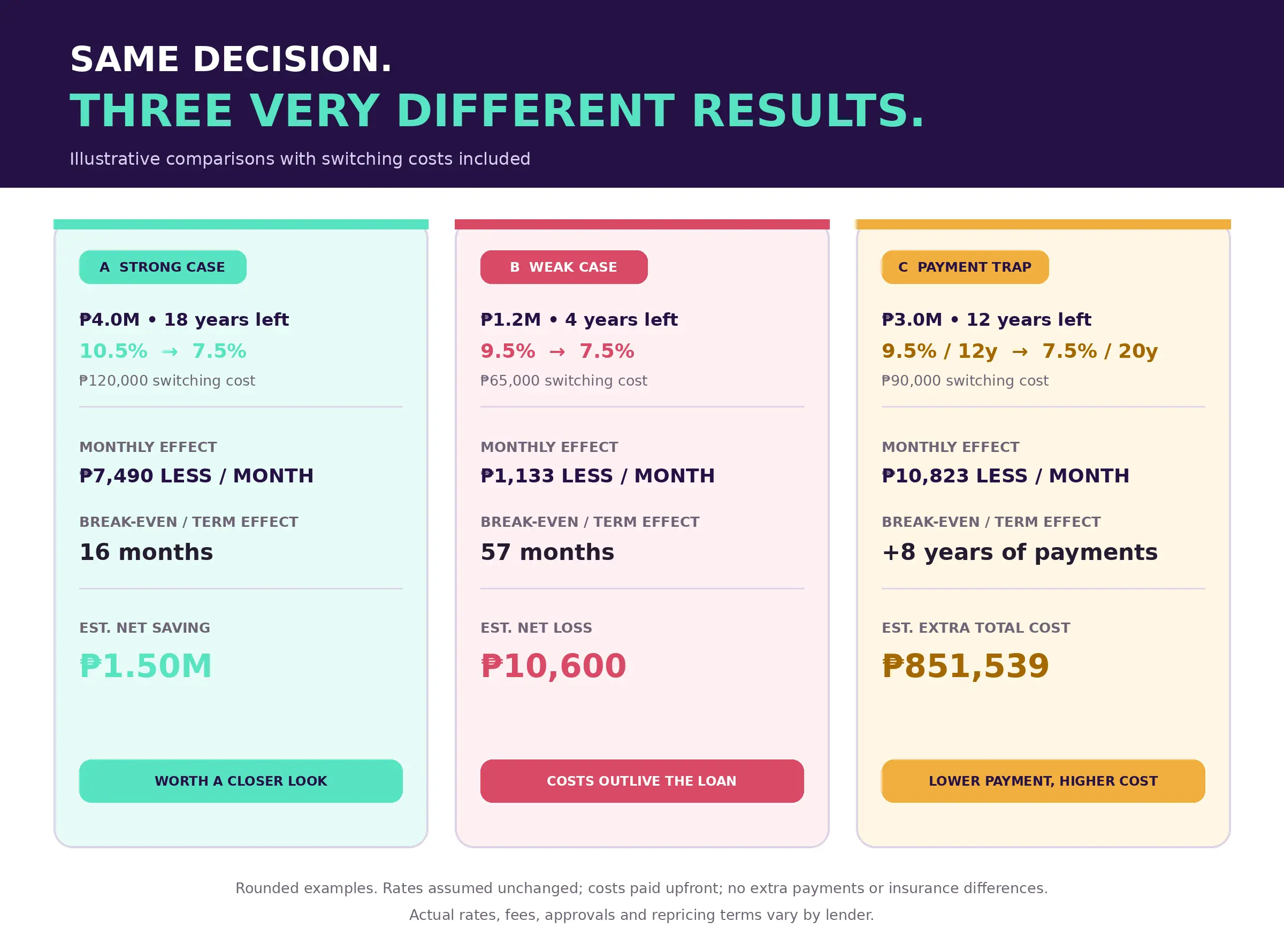
Example A: A Strong Refinancing Case
A homeowner has a ₱4 million balance and 18 years remaining at 10.5%. A new lender offers 7.5% for the same 18-year term, with ₱120,000 in estimated switching costs.
- Current payment: approximately ₱41,289 monthly
- New payment: approximately ₱33,799 monthly
- Monthly saving: approximately ₱7,490
- Simple break-even: approximately 16 months
- Estimated net saving over 18 years: approximately ₱1.50 million
If the borrower expects to keep the loan well beyond 16 months and is comfortable with the new fixing and repricing terms, refinancing has a strong financial case.
Example B: A Lower Rate That Fails to Save Money
Another homeowner has a ₱1.2 million balance and only four years remaining at 9.5%. A new lender offers 7.5% for the same four-year term, but switching costs are ₱65,000.
- Current payment: approximately ₱30,148 monthly
- New payment: approximately ₱29,015 monthly
- Monthly saving: approximately ₱1,133
- Simple break-even: approximately 57 months
- Original loan ends in: 48 months
- Estimated result after costs: approximately ₱10,600 more paid
The rate is lower, but the loan ends before the transfer costs are recovered. Staying—or asking the existing lender for a low-cost adjustment—would likely be better.
Example C: A Much Lower Payment That Costs More Overall
A homeowner has a ₱3 million balance and 12 years remaining at 9.5%. A refinancing offer provides 7.5%, but restarts the loan over 20 years and costs ₱90,000.
- Current payment: approximately ₱34,991 monthly
- New payment: approximately ₱24,168 monthly
- Monthly cash-flow relief: approximately ₱10,823
- Extra repayment time: eight years
- Estimated additional total cost: approximately ₱851,539
The new payment is far easier on the monthly budget, but it is not a savings strategy under these assumptions. It trades a lower payment today for more total cost and eight additional years of debt.
A Practical Refinancing Decision Checklist
Before proceeding, make sure you can answer these questions:
- What is the exact settlement amount for my current loan?
- What will I pay to my existing lender, the new lender, and third parties?
- What is the new EIR—not only the advertised interest rate?
- How long is the new rate fixed, and how will it reprice?
- What is the monthly payment using the same remaining term?
- What is the total remaining cost, including fees?
- How many months will it take to break even?
- Will I probably keep the loan beyond that point?
- Can the new bank finance the full settlement amount based on its appraisal?
- Has my current bank offered a competitive rate adjustment?
If the outside offer still wins after those questions, refinancing may genuinely improve the loan.
If the result depends on ignoring fees, extending the term, or assuming the first rate lasts forever, pause and recalculate.
Could Refinancing Improve Your Home Loan?
Estimate your potential savings or compare home-loan options from Philippine banks based on your situation and goals.
Refinance for a Clear Outcome
The best refinancing decisions begin with a specific objective. That may be lowering the total cost, creating sustainable monthly cash flow, paying the home off sooner, or securing a more suitable fixing period.
Use Estra’s refinancing calculator to compare your existing loan with a potential new loan using the same balance and repayment term.
Then test any longer-term option separately so the trade-off between immediate payment relief and total cost remains visible.
Sources
- Bangko Sentral ng Pilipinas — Loan Calculator and effective interest rate guidance
- Security Bank — Home Loan Refinancing
- Metrobank — Updates to car and home loan service fees
- Pag-IBIG Fund — Checklist of Requirements for Housing Loan Under Retail Accounts for Refinancing
Sources checked 20 October 2026. Bank policies, rates, fees, eligibility rules, and government requirements can change. Confirm the latest terms directly with the relevant lender or agency.